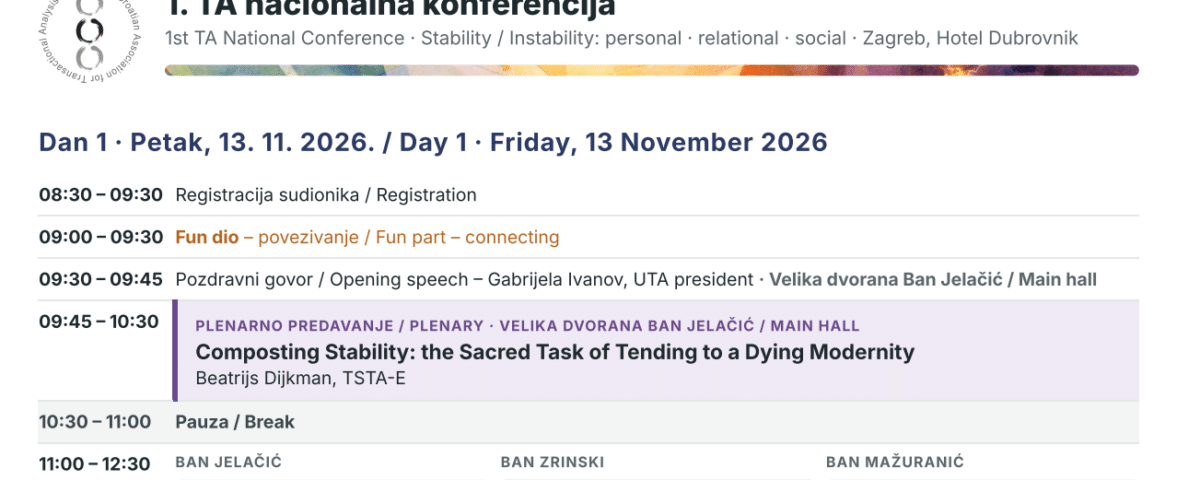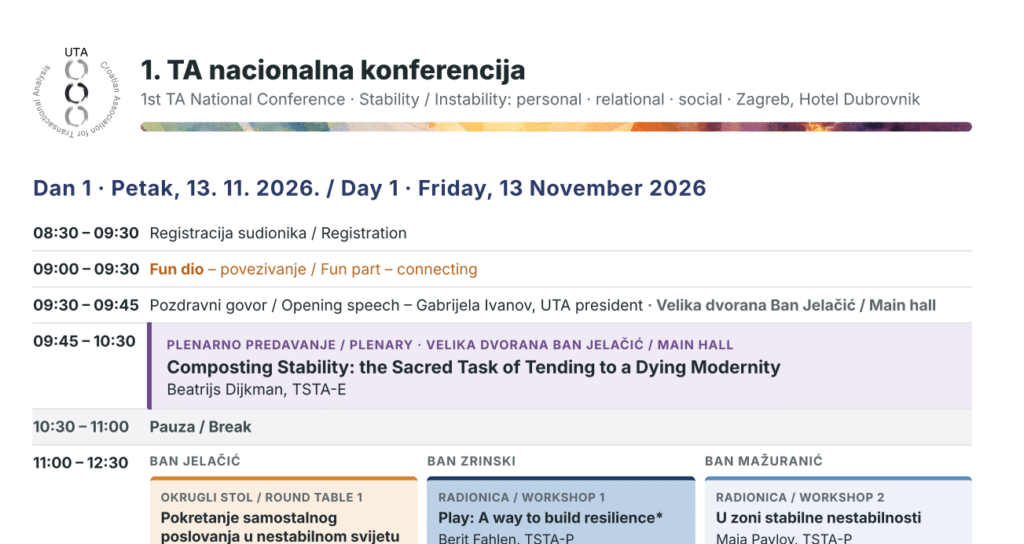
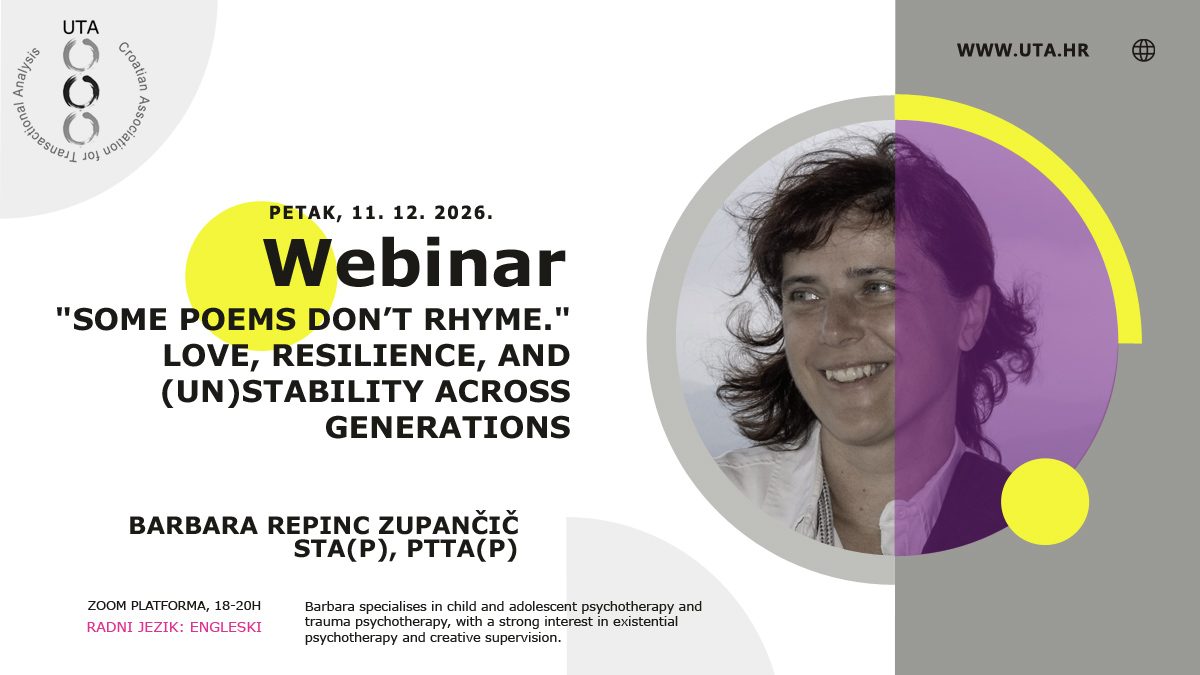
Pridružite nam se na prvom od dvaju webinara povezanih s temom nedavno završene Nacionalne TA konferencije, u organizaciji UTA-e, koji će održati Barbara Repinc Zupančič, STA(P), PTTA(P).
Mnogi od vas ostali su dirnuti Barbarinom radionicom tijekom 1. TA Nacionalne konferencije. Barbara je spremna još jednom podijeliti s nama svoje vrijedno znanje i iskustvo, ovoga puta u online formatu.
Datum: 11. prosinca 2026.
Vrijeme: 18:00 – 20:00 h
Iznos kotizacije:
- 10,00 € za sudionike i sudionice 1. TA Nacionalne konferencije
- 20,00 € za one koji nisu sudjelovali na konferenciji
Prijave putem obrasca:
https://forms.gle/
Dodatne informacije:
Dva dana prije početka webinara, poslat ćemo Zoom link sa mail adrese: edukacije.uta@gmail.
Webinar će se snimati.
Za one koji će sudjelovati na webinaru izdat ćemo potvrdu po završetku webinara unutar 14 dana.
O webinaru: “Some poems don’t rhyme.” Love, Resilience, and (Un)Stability Across Generations
Gilda Radner’s words capture a truth many individuals and communities are living today: life does not always resolve into coherence, fairness, or certainty – and yet, people continue to love, act, and remain present. In times of social, political, and ecological instability, individuals and communities often seek certainty and safety through patterns that may stabilise, but also rigidify, personal and relational life. From a Transactional Analysis perspective, such patterns can be understood as scripts, games, and stabilising transactions shaped by historical, cultural, and relational contexts. Drawing on Contextual Transactional Analysis (J. M. Sedgwick), existential perspectives on script (B. Heiller and C. Sills), E. Fromm’s understanding of love as a learnable practice and ethical action, and longitudinal and Indigenous resilience research, the workshop will examine how people and communities live with uncertainty across generations. Particular attention will also be given to bodily awareness in relation to the environment. Sensorimotor approaches (P. Ogden, J. Fisher) emphasise that healing and presence occur through a moving, responsive body rather than a static one. From a Transactional Analysis perspective, this can be understood as the domain of Physis. Participants will be invited to reflect on their own resilience resources and, optionally, to explore how previous generations may have faced instability, loss, and hardship. Through guided reflection, paired dialogue, creative expression, and gentle body awareness, the workshop will consider when stability supports growth and when it becomes rigidity, how unspoken existential realities contribute to scripts and psychological games and how courage, everyday actions of love, meaning-making, and relational presence function as grounded forms of resilience and realistic hope in unstable contexts.
O Barbari:
My primary education is in pedagogy and the sociology of culture. Throughout my career, I have worked in a variety of social service roles, including child and youth protection, domestic violence work, prevention work with young people, and work with people who misuse drugs. I have had my own private psychotherapy practice since 2008. I have completed training in Transactional Analysis (Psychotherapy). I specialise in child and adolescent psychotherapy and trauma psychotherapy, with a strong interest in existential psychotherapy and creative supervision. I am an Integrative Supervisor and a TA Supervisor, STA (P). I teach and supervise in Slovenia and abroad. In my work, I use everything I have found useful in my life, including practices that come from my sources of joy, such as gardening, travelling, mountaineering, and various kinds of handicrafts. In preparing this workshop, I returned to my student years more than 30 years ago, when I was encouraged to read Freud, Lacan, and Durkheim, and, with that knowledge, to interview older “ordinary” people (farmers and workers) about how they survived the horrors of World War II and what survival mechanisms they developed. The hope I gained from that work – real, grounded hope – still supports me when I am dealing with my own difficult situations, and this is what I would like to share with my colleagues in the workshop.